



Our client-side Facial Emotion AI solution delivers not just one, but seven standout benefits: privacy, capability, real-time reaction, scalability, competitive pricing, low carbon footprint, and a responsible approach.
Privacy
MorphCast Emotion AI processes facial expressions strictly on the user’s device. The analysis runs in your browser, guaranteeing that your facial data remains on your device. Furthermore, we specifically designed our AI engine not to recognize or identify individuals. With MorphCast, user’s privacy is in very good hands.
A server-free Emotion AI technology that protects privacy
MorphCast Emotion AI is a cutting-edge technology that uses Facial Emotion Recognition to detect and interpret emotions, but with a strong emphasis on user privacy. Unlike other emotion analysis systems that work on the cloud, MorphCast Emotion AI processes analysis entirely in the browser of the user’s device. Our team has no control over the personal data represented by your face, but only over statistical, aggregated, and anonymous emotional data. And you can’t consider these data private since you can’t associate them with natural persons.
MorphCast’s SDK is designed to be GDPR-compliant and adhere to all privacy regulations, ensuring maximum protection of user data. The core principle behind it is that emotional data analysis happens locally within the user’s browser, without ever transferring any personal information to MorphCast’s servers.
This architecture provides key privacy advantages:
- Local data processing: Emotional analysis is performed entirely within the user’s browser, with no images or personal data being sent to external servers. MorphCast does not collect, store, or transfer any information that could identify the user.
- Anonymous data transmission: The only data sent to the servers are aggregated emotion metrics associated with the experience’s timestamps. No user-related data, such as IP addresses, cookies, or other identifying information, is ever transmitted.
- Complete anonymization: The data transmitted is fully aggregated and anonymous, not pseudonymous. This means there is no way to trace back to the user’s identity, unlike competitors who often rely on cloud servers to analyze facial expressions and may process images of the user, which exposes them to privacy risks.
In summary, MorphCast’s approach ensures full compliance with privacy regulations, protecting users from exposure of personal data and providing a secure alternative to cloud-based solutions that require the transfer of sensitive information.
MorphCast Emotion AI uses the device’s camera as a sensor, not as a video image recorder.
This means that we do not record or transmit facial data to the cloud for analysis. And ensures that the user’s face remains on their device and nobody can share it with any third-party. This is essential to neutralize the risk of accessing or using the data without the user’s consent.
Furthermore, we have specifically designed MorphCast Emotion AI so that it does not recognize or identify individuals, nor their behaviors. Each analysis is conducted on a face unknown to the AI engine. By instantly substituting one’s face with another, the AI continues to track the immediate emotions without recognizing the change of person, ensuring anonymity and privacy. We achieved this by using Facial Emotion Recognition algorithms that cannot identify specific individuals.
Overall, MorphCast Emotion AI offers a unique solution for users who want to benefit from the technology’s capabilities without compromising their privacy. This can be particularly useful in situations where users may be concerned about the security and privacy of their data. For example, in the case of sensitive information or personal use. It also has many potential applications in fields such as marketing, digital learning and recruiting.
We are constantly committed to complying with the various privacy regulations.
Discover more on how MorphCast Emotion AI protects privacy and preserves people’s rights.
Capabilities
MorphCast is the most comprehensive facial emotion recognition solution on the market thanks to more than 100 capabilities in facial expression recognition (FER).
Leveraging the renowned Circumplex Model of Affect developed by Russel, MorphCast offers a comprehensive and precise exploration of user emotional states. This model allows for a nuanced understanding of emotions, positioning them within a two-dimensional space, and our AI harnesses its depth to provide insights into the intricacies of an individual’s state of mind.
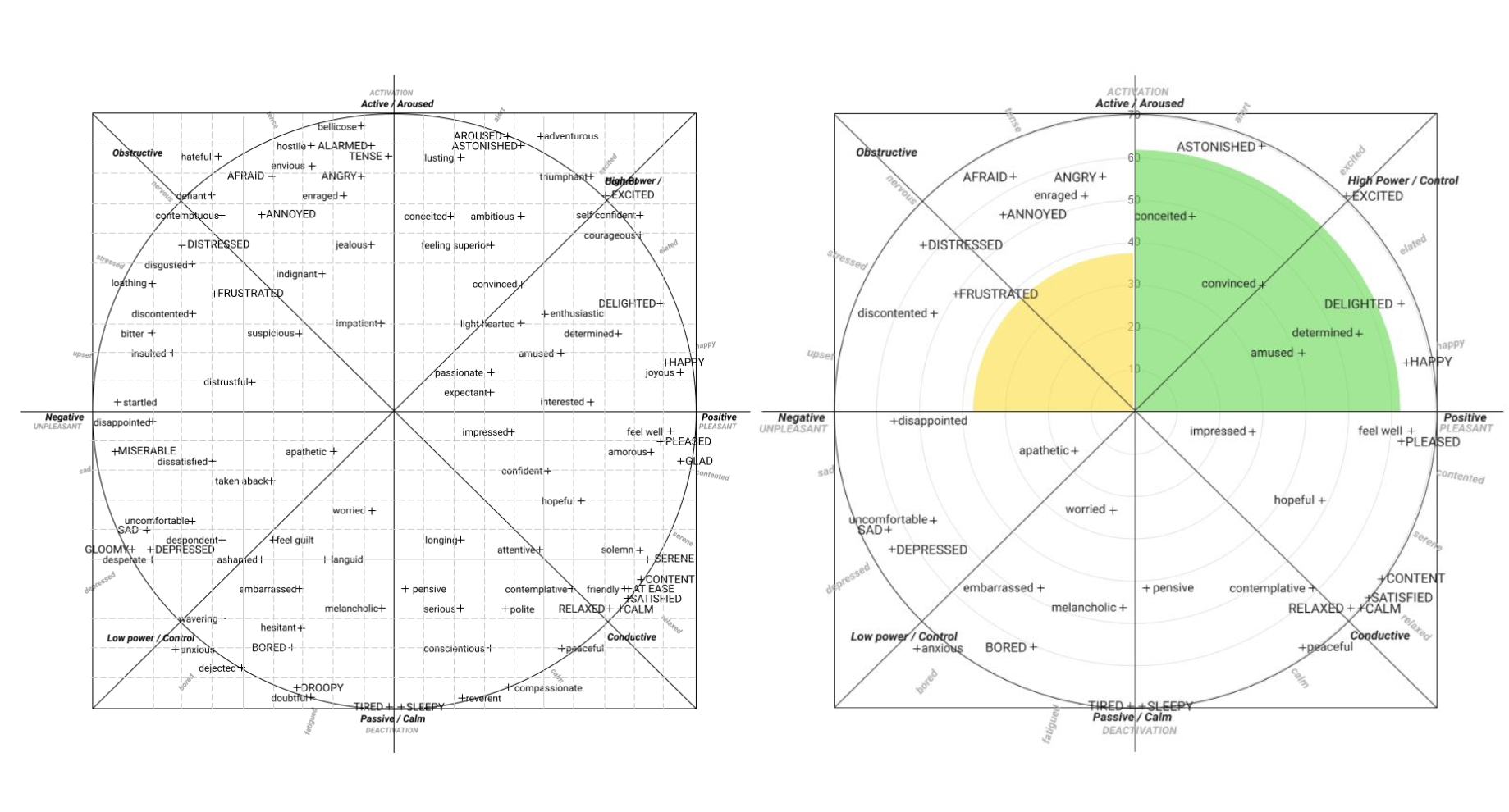
MorphCast features a compact yet powerful server-free AI engine capable of extracting the following facial data about an individual:
- Face detector: Detects the presence of a face in the field of view of the webcam or input image.
- Pose: Estimates the head pose rotation angles expressed in radians as pitch, roll, and yaw.
- Age: Estimates the likely age of the main face with a granularity of years, or within an age group for better numerical stability.
- Gender: Estimates the most likely gender of the main face, Male or Female.
- Emotions: Estimates the presence and the respective intensities of facial expressions in the format of seven core emotions – anger, disgust, fear, happiness, sadness, and surprise, plus the neutral expression – according to the Ekman discrete model.
- Arousal Valence: Estimates the emotional arousal and valence intensity. According to the dimensional model of Russell. Arousal is the degree of engagement (positive arousal), or disengagement (negative arousal); valence is the degree of pleasantness (positive valence), or unpleasantness (negative valence) completing the analysis with the probability of proximity to 98 different mental states: Adventurous, Afraid, Alarmed, Ambitious, Amorous, Amused, Angry, Annoyed, Anxious, Apathetic, Aroused, Ashamed, Astonished, At Ease, Attentive, Bellicose, Bitter, Bored, Calm, Compassionate, Conceited, Confident, Conscientious, Contemplative, Contemptuous, Content, Convinced, Courageous, Defiant, Dejected, Delighted, Depressed, Desperate, Despondent, Determined, Disappointed, Discontented, Disgusted, Dissatisfied, Distressed, Distrustful, Doubtful, Droopy, Embarrassed, Enraged, Enthusiastic, Envious, Excited, Expectant, Feel Guilt, Feel Well, Feeling Superior, Friendly, Frustrated, Glad, Gloomy, Happy, Hateful, Hesitant, Hopeful, Hostile, Impatient, Impressed, Indignant, Insulted, Interested , Jealous, Joyous, Languid, Light Hearted, Loathing, Longing, Lusting, Melancholic, Miserable, Passionate, Peaceful, Pensive, Pleased, Polite, Relaxed, Reverent, Sad, Satisfied, Selfconfident, Serene, Serious, Sleepy, Solemn, Startled, Suspicious, Taken Aback, Tense, Tired, Triumphant, Uncomfortable, Wavering, Worried.
- Attention: Estimates the attention level of the user to the screen, considering whether the user’s face is in or out of the field of view of the webcam, head position and other emotional and mood behavior.
- Wish: Estimates the value of the MorphCast® Face Wish index. This is a proprietary metric that, considering the interest and sentiment of a customer, summarizes in a holistic manner his/her experience about a particular content or product presented on the screen.
- Positivity: Gauges the intensity of arousal and valence based on the 17-degree angle of the circumflex model of affects (Russel). This exclusive metric provides a comprehensive overview of an individual’s positivity, capturing facial expressions.
- Alarms: Several alarm are outputing by the AI engine to help developer to trigger reactions at possible cheating situations (NO FACE, MORE FACES, LOW ATTENTION…).
- Other Features: Estimates the presence of the following face features: Arched Eyebrows, Double Chin, Narrow Eyes, Attractive, Earrings, Necklace, Bags Under Eyes, Eyebrows Bushy, Necktie, Bald, Eyeglasses, No Beard, Bangs, Goatee, Oval Face, Beard 5 O’Clock Shadow, Gray Hair, Pale Skin, Big Lips, Hat, Pointy Nose, Big Nose, Heavy Makeup, Receding Hairline, Black Hair, High Cheekbones, Rosy Cheeks, Blond Hair, Lipstick, Sideburns, Brown Hair, Mouth Slightly Open, Straight Hair, Chubby, Mustache, Wavy Hair.

Bibliography:
- Russell, J., Lewicka, M. & Niit, T. (1989). A cross-cultural study of a circumplex model of affect. Journal of personality and social psychology, 57, 848–856.
- Scherer, Klaus. (2005). Scherer KR. What are emotions? And how can they be measured? Soc Sci Inf 44: 695-729. Social Science Information. 44. 695-792.
- Ahn, Junghyun & Gobron, Stéphane & Silvestre, Quentin & Thalmann, Daniel. (2010). Asymmetrical Facial Expressions based on an Advanced Interpretation of Two-dimensional Russells Emotional Model.
- Paltoglou, G., & Thelwall, M. (2012). Seeing stars of valence and arousal in blog posts. IEEE Transactions on Affective Computing, 4(1), 116-123.
- Paul Ekman Basic-Emotions
Real-time reaction
No bandwidth consumption or server latency for real-time reaction
MorphCast AI’s server-free processing allows for real-time reaction and adaptation of content based on the emotions detected. Since we process facial data on the user’s device, there is no need to wait for a server to process the data and send it back. This eliminates latency, which is the delay caused by sending data to a server, waiting for it to be processed, and receiving a response. In addition to this, there is no bandwidth consumption due to the streaming of the camera to be sent to the server for analysis.
This means that emotional data can drive in real time the adaptation of content on the user’s device. There is no lack of continuity, and it’s crucial for creating a more personalized and engaging experience.
Use cases examples
Gaming. You can create more immersive and personalized gaming experiences by detecting and responding to player emotions in real-time. Additionally, since MorphCast processes emotional data locally, you can use it to trigger immediate actions that depend on the emotional state of the user.
eLearning. You can detect and respond to students’ emotional states, adapt content and teaching style for better engagement and retention. Or you can monitor student engagement and attention levels during an on demand course and adjust scenes with alternative teaching methods accordingly. Also, you can create personalized learning paths based on the student’s emotional state, learning style, and pace. And you can provide gamified and interactive learning experiences that respond to students’ emotions and preferences.
Job interview coaching. You can analyze the emotional state of candidates during mock interviews, providing real-time feedback on body language and nonverbal cues. Or you can monitor the candidate’s stress levels and provide relaxation exercises to reduce anxiety before the real interview. You can also provide data-driven insights on the candidate’s emotional strengths and areas for improvement to guide their coaching. Or create a simulation of a real-life job interview scenario that adapts to the candidate’s emotional state and provides personalized feedback and suggestions.
In other use cases, you can detect the emotions felt while watching a video. And use these data to trigger the user’s tastes or lifestyles with a certain approximation, to propose products or services.
Scalability
Total scalability because the MorphCast Emotion AI engine, working on the client side, uses the resources of each individual client. This fact completely solves every bottleneck of a cloud infrastructure.
Server-free technology for complete scalability
The scalability is an important feature for any technological system. And it is crucial for those who would have to manage large amounts of data or users. In traditional systems, the ability to scale is often limited by the resources of a central server or cloud infrastructure. However, we designed MorphCast Emotion AI engine to work on the client-side as a server-free technology. This allows it to take advantage of the resources of each individual client to handle increasing loads and demands.
One of the major advantages of server-free processing is the elimination of a central server or cloud infrastructure as a bottleneck. In traditional systems, a central server or cloud infrastructure can become overwhelmed when handling large amounts of data or users. This can lead to slow performance and even system crashes. However, by using the resources of each individual client, MorphCast Emotion AI engine can handle increasing numbers of users with simultaneous requests without any degradation in performance.
Another advantage of server-free processing is that it does not rely on a constant internet connection. Many cloud-based systems require a constant internet connection to function properly. This can be a limiting factor in remote or offline environments. However, MorphCast Emotion AI engine can continue to function even if there are temporary disruptions in internet connectivity. And this makes it more versatile and reliable.
Furthermore, the server-free system does not consume bandwidth to send camera video streaming to a server, eliminating the user’s bandwidth cost compared to a server-side system.
Reliable, versitle, useful and effective
In conclusion, the use of server-free resources in MorphCast Emotion AI engine allows for total scalability. By eliminating the need for a central server or cloud infrastructure, and by not relying on a constant internet connection, the system can handle an increasing amount of load or demand without any degradation in performance. This makes it more reliable, versatile, useful and cost effective in all scenarios.
Minimal bandwidth consumption
MorphCast’s innovative approach guarantees minimal bandwidth consumption, ensures reliable performance, operates offline, enhances security, and offers fast, responsive interactions, all without requiring additional software installations.
Bandwidth Savings
One of MorphCast’s key advantages is that it doesn’t require constant data transmission to external servers. All AI processing happens directly in the user’s browser. This means minimal bandwidth consumption and makes it ideal for users with data limitations or expensive connections.
Functioning with Unreliable Internet Connections
MorphCast is designed to be robust even with unreliable or intermittent internet connections. Once the AI model is loaded in the browser, the application continues to function smoothly even if the internet connection is weak or unstable, ensuring an uninterrupted user experience.
Offline Operation
Another notable advantage of MorphCast is its ability to function completely offline. After the initial AI model loading, users can continue to use all MorphCast features without an active internet connection. This is particularly useful in situations where internet access is limited or unavailable, ensuring the AI is always accessible.
Would you like to test it? Start our live demo from your device and then switch to airplane mode: you will see that the analysis will continue even offline!
Compatibility and Ease of Access
MorphCast works on any device with a compatible browser, without the need to install additional software. This makes it easily accessible to a wide range of users, facilitating the adoption and implementation of AI technology in various contexts.
Carbon Neutral Program
At MorphCast, we are deeply committed to minimizing our impact on the environment and mitigating the effects of climate change. We recognize the urgent need to take action and have made it our mission to implement sustainable practices throughout our operations and product development. With our carbon neutral program, our goal is to reduce our carbon footprint as much as possible and offset any remaining emissions we are unable to eliminate. We believe that by taking responsibility for our environmental impact, we can contribute to a healthier and more sustainable future for all.
How we have been working for a time to reduce our carbon footprint
We believe it is our responsibility as a company to take action to address climate change. We have long been doing our part to create a more sustainable future for all with our carbon neutral program.
One of the ways we have done this is to reduce the carbon footprint of our software architecture and products. This includes designing software that is energy-efficient and uses the infrastructure more efficiently.
We have already taken some actions towards this goal since 2019, like:
- becoming a fully remote company, which reduces the carbon footprint associated with commuting
- designing our software to work on the client side instead of a server side. This reduces the energy consumption associated with data centers
- abandoning our local AI servers in favor of multi-use and globally scalable cloud architectures. This enables our host provider to share resources, reducing energy consumption and costs
- using dynamic lambdas instead of dedicated servers to power our services. It allows us to consume resources only when needed, scale efficiently and reduce costs. Also, it enables us to redirect those savings towards other sustainability and environmental initiatives.
In addition to these efforts, we also implemented a carbon offset program. This mitigates any remaining emissions that we are unable to eliminate. This includes investing in carbon offset projects such as reforestation and clean energy.
We understand that reducing our carbon footprint is an ongoing process. We regularly review and update our sustainability efforts. Also, we plan to transparently report our progress and set ambitious targets to continue to reduce our carbon footprint over time.
For more details, please check the page MorphCast Carbon Neutral program.
Ethics and Guidelines for a Responsible Approach to Emotion AI
MorphCast advocates a responsible approach to the development and use of artificial intelligence technologies.
At MorphCast, we have established a code of ethics to ensure ethical and responsible approach to Emotion AI from all parties involved. We expect our customers to uphold these standards and abide by the guidelines for the responsible use of artificial intelligence.
MorphCast Guidelines and Policies for Responsible Use of Emotion AI highlight the importance of obtaining explicit and informed consent from individuals before collecting or processing their emotional data. This includes making sure that individuals understand the purpose of the Emotion AI, how their data will be used, and any potential risks or benefits associated with participating. You should also give individuals the opportunity to opt-in or opt-out of the data collection or processing. Obtaining explicit and informed consent is important. Your users need to be aware of how you use their emotional data. And you need to make sure they have the ability to make an informed decision about whether or not to participate.
Privacy and dignity
The guidelines also recommend designing and using Emotion AI systems in a way that respects the privacy and dignity of individuals. This includes:
- obtaining explicit consent from individuals,
- protecting the privacy of individuals by securely storing and handling personal data in accordance with relevant laws and regulations,
- avoiding using Emotion AI systems to make decisions that could have significant impacts on individuals without providing a transparent and fair process for individuals to challenge or appeal these decisions,
- ensuring that Emotion AI systems are not used in a way that discriminates against or unfairly disadvantage any particular group of individuals,
- regularly reviewing and updating the design and use of Emotion AI systems to ensure that they continue to respect the privacy and dignity of individuals.
Transparency
We also advise you on how to be transparent about the capabilities and limitations of Emotion AI systems. And communicating this information clearly to users. This can help users understand the potential benefits and limitations of using these systems. Helps them to make informed decisions about whether and how to use them.
Recommendations for being transparent include:
- clearly explaining the purpose and intended use of the Emotion AI system to users,
- providing information about any assumptions or biases that may be present in the data or algorithms,
- disclosing any known limitations of the system, its accuracy or ability to handle certain types of inputs or contexts,
- communicating the potential risks and benefits of using the Emotion AI system to users,
- providing guidance on how to use the system safely and effectively.
Do you want a detailed insight? Click here!
Good overall awareness of the potential impacts of the AI system
MorphCast partners with RedOpen, a spin-off of the University of Milano-Bicocca, leveraging the power of tools like AI Check & Go™ and AI Check & Audit™. Together, we support a future where AI is designed, developed, and adopted with the utmost responsibility, always upholding ethical standards, regulatory compliance, and principles of corporate social responsibility.