


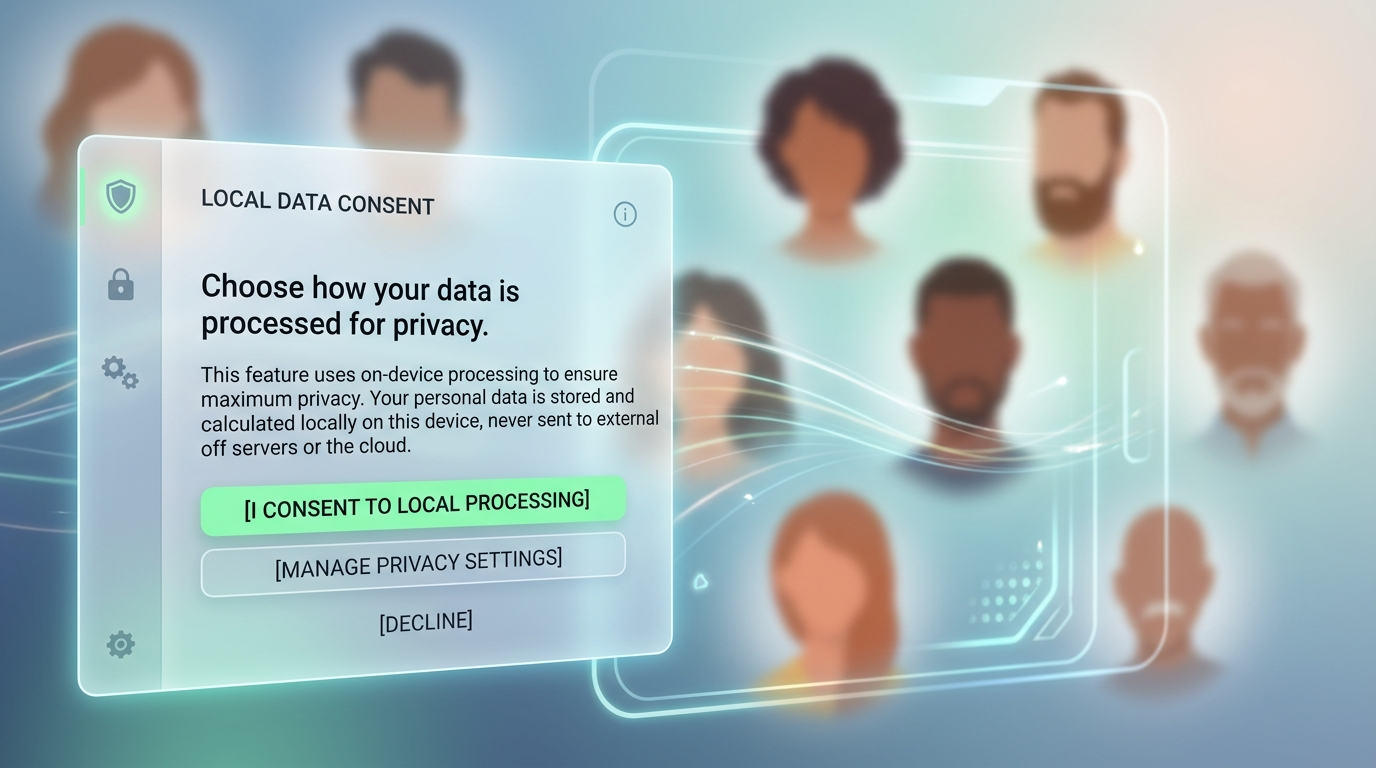
The Trust Moment Comes Before the Technology
The first responsible Emotion AI interface is not the model. It is the moment before the camera turns on.
A person is about to enter an interactive experience. Maybe it is a learning module, a brand story, a product demo, or a digital support journey. The system could adapt the experience based on visible engagement signals. But before anything intelligent happens, something more important must happen first: the user must understand what is going on.
No vague banner. No hidden permission buried inside a privacy policy. No “by continuing you agree” trick that makes consent feel like a trapdoor. Just a clear explanation, a real choice, and a design that respects the person on the other side of the screen.
That is where responsible Emotion AI begins. Not with a dashboard. Not with a prediction. Not with a promise that the system “understands” people. Responsible Emotion AI begins with trust, and trust begins with consent and transparency.
Here is the practical thesis: consent is necessary, but it is not enough. Responsible use also requires purpose limitation, privacy-by-design architecture, honest communication about limitations, human oversight, and a product experience that gives users meaningful control.
What Responsible Emotion AI Means
Responsible Emotion AI is the use of emotion-related or engagement-related signals in a way that is clear, optional, proportionate, privacy-conscious, and useful to the person or organization using it.
In practice, that means the system should have a specific purpose, such as adapting interactive content, improving an online learning experience, identifying moments of friction in a digital journey, or helping teams understand aggregate engagement patterns. It should not be used as a hidden surveillance layer, a tool for punitive decisions, or a substitute for human judgment in high-impact contexts.
This distinction matters because Emotion AI interacts with human signals that feel personal. Facial expressions, attention cues, and emotional responses are not ordinary analytics events. They sit close to identity, context, mood, culture, lighting conditions, accessibility, and human variability. A responsible product does not pretend these signals are perfect, universal, or equivalent to reading someone’s inner state.
A better way to frame Emotion AI is as a probabilistic, context-sensitive input for improving experiences. It can help a digital experience become more responsive. It can support better pacing, more relevant content, or aggregate insight into where users lose interest. But it should not be presented as a definitive judgment of what someone feels, wants, or intends.
The Regulatory Signal Is Clear: Emotion AI Needs Extra Care
The regulatory landscape is moving in the same direction: AI systems that infer emotions deserve heightened scrutiny. The EU AI Act defines an emotion recognition system as an AI system used to identify or infer emotions or intentions of natural persons on the basis of biometric data. It also prohibits AI systems that infer emotions in workplace and education contexts, except for medical or safety reasons.
For allowed contexts, the EU AI Act also includes a transparency duty: deployers of emotion recognition systems must inform people exposed to the system that it is operating, and must process personal data in accordance with applicable data protection law.
Consent is not a magic wand. Under the European Commission’s guidance on valid consent, consent should be freely given, informed, specific, explicit, clearly visible, written in plain language, and easy to withdraw. Where there is a power imbalance, such as employer and employee, consent may not be freely given.
Responsible AI frameworks point in the same direction. The NIST AI Risk Management Framework encourages organizations to manage risks to individuals, organizations, and society across the AI lifecycle. UNESCO’s Recommendation on the Ethics of Artificial Intelligence places human rights, dignity, transparency, fairness, and human oversight at the center of AI governance. The OECD AI Principles similarly emphasize trustworthy AI that respects human rights and democratic values.
This article is not legal advice. It is a practical product and governance guide. Any organization deploying Emotion AI should review the laws that apply to its geography, sector, users, and use case.
Consent Must Be a Real Product Choice, Not a Checkbox
The weakest consent pattern is the one users barely notice. The strongest consent pattern is the one users understand immediately.
For Emotion AI, consent should answer six questions before activation:
- What will be analyzed?
- Why is it being analyzed?
- Where does the processing happen?
- What data is stored, if anything?
- Who receives the output?
- How can the user refuse, pause, or withdraw consent?
A responsible consent screen might say something like this: “This experience can use your camera to estimate visible expression and engagement signals so the content can adapt in real time. The analysis runs on your device. Facial images are not sent to MorphCast servers for analysis. You can continue without enabling this feature.”
The exact language must match the actual implementation. If video is stored, say so. If outputs are sent to a dashboard, say so. If data is aggregated, explain what aggregation means. If a third party receives data, name the purpose. Trust collapses when the interface promises simplicity but the architecture tells a different story.
Good consent is also reversible. A user should be able to stop the feature without losing access to the whole experience, unless the Emotion AI function is strictly necessary for the service and that necessity is clearly justified. In most engagement, media, training, and UX optimization scenarios, participation should be optional.
Transparency Is a UX Pattern
Transparency should not live only in legal documents. It should be built into the user journey.
Before the experience starts, transparency means clear notice and choice. During the experience, it means visible indicators when the camera or AI-powered adaptation is active. After the experience, it means accessible information about what happened, what data was used, and how the user can exercise rights or ask questions.
The best transparency patterns are calm and specific. They do not scare users with technical complexity, and they do not pacify them with empty reassurance. They explain the system in human terms.
For example, “We use your camera to understand whether this part of the experience feels engaging or confusing” is clearer than “We process multimodal affective signals for adaptive optimization.” The second sentence may impress a committee. The first one helps a person decide.
Transparency also means communicating limits. Emotion AI should not be described as mind reading. It estimates visible signals. It can be affected by context, lighting, device quality, facial visibility, culture, expression style, disability, fatigue, and many other factors. A responsible interface says what the technology can do and what it cannot do.
Product Design Guidelines for Responsible Emotion AI
Responsible implementation starts before the first line of integration code. It starts with product design.
- Start with the value stream. Define the specific user value before defining the data. Do not ask, “What can we detect?” Ask, “What user problem are we solving?”
- Use the least sensitive architecture that can do the job. If real-time adaptation can work with local processing, avoid sending raw facial data to cloud servers.
- Treat the camera as a sensor, not a recorder. In many use cases, the system only needs momentary signals to adapt content. It does not need to keep images or identify the person.
- Make participation optional. Provide a meaningful non-camera path wherever possible.
- Separate experience adaptation from user evaluation. Using engagement patterns to improve content is very different from scoring people.
- Avoid high-impact decisions. Emotion AI outputs should not independently drive hiring, firing, grading, access to services, medical decisions, financial decisions, or other similarly significant outcomes.
- Explain uncertainty. Use language such as “estimated,” “signals,” “patterns,” and “may indicate,” rather than absolute claims.
- Review fairness and accessibility. Test performance across devices, lighting conditions, skin tones, facial visibility, age groups, and accessibility contexts.
- Create a redress path. Users should know how to ask questions, report concerns, or challenge misuse.
- Document the decision. Keep a lightweight record of purpose, data flow, consent language, retention, safeguards, testing, and review dates.
These guidelines are not bureaucracy for its own sake. They are how product teams prevent trust from becoming an afterthought.
Value Stream Examples: Where Responsible Use Creates Value
The most responsible Emotion AI use cases are not the ones that collect the most signals. They are the ones that create the clearest value with the least unnecessary data.
Interactive learning and training
In a learning experience, engagement signals can help identify where content becomes confusing, too fast, or too passive. The value is not “judging the learner.” The value is improving the learning journey: slowing down a module, offering a recap, changing the format, or helping instructional designers understand where friction appears.
Education and workplace settings require particular caution. In the EU, emotion inference in workplace and education contexts is prohibited under the AI Act except for medical or safety reasons. Even outside the EU, responsible design should avoid using emotion-related signals to evaluate students, employees, candidates, or individuals in power-imbalanced relationships.
Healthcare and patient communication
Emotion-aware interaction can help make patient education more understandable, supportive, and responsive. For example, an educational experience may adapt its pace when many users appear confused or disengaged. But the boundary must be clear: Emotion AI should not be used as a diagnostic tool, a clinical judgment engine, or a substitute for professional care unless specifically validated, regulated, and governed for that purpose.
Interactive media and brand experiences
Interactive video, storytelling, product demos, and digital campaigns are strong candidates for opt-in Emotion AI because the value can be immediate and understandable. The experience responds to the viewer. The story adapts. The content becomes more relevant. The responsible boundary is equally clear: no hidden profiling, no covert retargeting based on emotional signals, and no manipulation of vulnerable users.
Product research and UX optimization
Aggregate engagement patterns can help product teams understand where people hesitate, lose attention, or respond positively. This can improve design quality without turning every user into a profile. The safest version is purpose-limited, aggregate, opt-in, and separated from individual identity wherever possible.
How MorphCast Fits Into a Responsible Implementation
MorphCast’s position is that Emotion AI should make digital experiences more human-centered without becoming more invasive. That is why MorphCast emphasizes transparency, privacy, and responsible use in its Responsible Guidelines and its broader work on building trustworthy Emotion AI.
Architecture is part of that responsibility. As explained in MorphCast’s article on client-side Emotion AI and privacy, processing emotion-related signals directly in the browser or on the user’s device can reduce unnecessary data movement. In plain English: the face does not need to travel to a server when the experience can work locally.
This does not remove the need for consent, notice, governance, or legal compliance. It does create a better starting point. A client-side architecture supports data minimization, real-time responsiveness, scalability, and a simpler explanation to users: the system can respond to visible engagement signals without requiring raw facial video to be sent away for analysis.
MorphCast should be used as part of a responsible design process, not as a shortcut around one. The strongest implementation combines technical minimization with clear consent, honest transparency, appropriate safeguards, and a well-defined value stream.
A Pre-Launch Checklist for Responsible Emotion AI
Before launching an Emotion AI experience, teams should be able to answer these questions in plain language:
- What is the user benefit?
- Is Emotion AI necessary for that benefit, or merely interesting?
- What exactly is being analyzed?
- Is the use case allowed under applicable AI, privacy, biometric, consumer protection, education, employment, and sector-specific laws?
- Is consent freely given, specific, informed, explicit, and easy to withdraw?
- Can users access a non-camera alternative?
- Where does processing happen?
- Are facial images or video streams stored, transferred, or shared?
- Are outputs tied to identity, or can they remain local, ephemeral, anonymous, or aggregate?
- Who can access the results?
- Could the output affect someone in a significant way?
- How are accuracy limits, bias risks, and environmental conditions communicated?
- What human oversight exists?
- How can users report concerns?
- When will the use case be reviewed again?
If the team cannot answer these questions clearly, the product is not ready. Not because Emotion AI is impossible to use responsibly, but because responsible use requires more than technical capability.
The Real Goal: Trustworthy Adaptation
The future of digital experiences will be more adaptive. Content will respond more intelligently. Interfaces will become more aware of friction. Learning, media, support, and product experiences will feel less static and more conversational.
But adaptation without trust becomes extraction. Personalization without transparency becomes manipulation. Intelligence without boundaries becomes risk.
Responsible Emotion AI offers a better path. It uses human signals to improve the experience, not to judge the person. It explains itself before acting. It asks for permission. It minimizes data. It avoids high-impact decisions. It respects the limits of what AI can infer. And it gives people a real choice.
The best Emotion AI will not be the technology that claims to know people completely. It will be the technology that knows its limits, serves a clear purpose, and earns trust one transparent interaction at a time.
FAQ: Emotion AI, Consent and Transparency
What is responsible Emotion AI?
Responsible Emotion AI uses emotion-related or engagement-related signals with clear notice, informed consent, privacy-first design, purpose limitation, human oversight, and meaningful user control. It should improve an experience without becoming hidden surveillance or a tool for high-impact decisions.
Is consent enough to make Emotion AI responsible?
No. Consent is essential, but it is not enough. A responsible system also needs an appropriate purpose, data minimization, transparency, security, fairness review, user control, and safeguards against misuse.
What should an Emotion AI consent notice include?
An Emotion AI consent notice should explain what is analyzed, why it is analyzed, where processing happens, whether data is stored or shared, who receives the output, and how the user can refuse or withdraw consent. The language should be clear, specific, and visible before activation.
Can Emotion AI work without storing facial images?
Yes, in some architectures. Client-side Emotion AI can process signals locally in the browser or on the device, reducing the need to send facial images or video streams to cloud servers. This supports data minimization, but it does not remove the need for consent and transparency.
What uses of Emotion AI should companies avoid?
Companies should avoid hidden monitoring, manipulative personalization, emotional profiling without consent, and any use where Emotion AI independently drives hiring, grading, employment, medical, financial, legal, or similarly significant decisions about people.
How can Emotion AI build user trust?
Emotion AI can build trust when users understand the purpose, can make a real choice, know what happens to their data, see clear limits, and receive value from the experience. Trust comes from design, architecture, and governance working together.